


• This site contains eBay affiliate links for which Sea-Doo Forum may be compensated.

1996 SPI Used 587 Engine Swap (With Pics) - Options, Rebuild or Run?

My 96 SPI engine lost compression on one of the cylinders last summer (suspect crank bearings) so I picked up a used running 587 engine that has sat for a year or more so and am wondering on best options for it and am looking for advice and comments on each option :

1) Pressure test, hone cylinder walls, change top end gaskets, and run it as is.
2) Top end rebuild
3) Split cases to put new outer crank seals in in addition to top end rebuild.

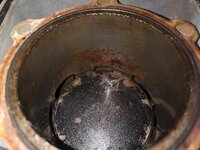
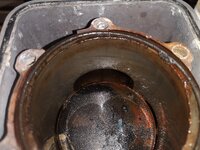
Would a light sanding of the cylinder walls suffice or does it need a hone? Hows the cylinder wash look?

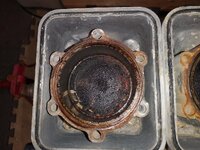
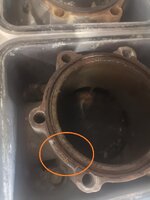
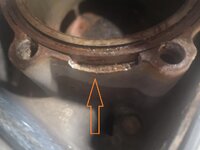
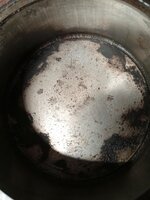
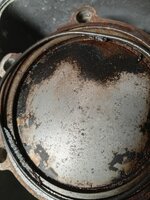
Pics of the used 587 engine :
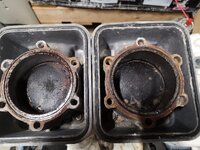
cover off pic.jpgfront cylinder pic.jpgrear cylinder pic.jpgrust in cylinder sleeve.jpgcylinder sleeve marks 2.jpg
 
Last edited:
My 96 SPI engine lost compression on one of the cylinders last summer (suspect crank bearings) so I picked up a used running 587 engine that has sat for a year or more so and am wondering on best options for it and am looking for advice and comments on each option :

1) Pressure test, sand/hone cylinder walls, change top end gaskets, and run it as is.
2) Top end rebuild
3) Split cases to put new outer crank gaskets in in addition to top end rebuild.

Would a light sanding of the cylinder walls suffice or does it need a hone? Hows the cylinder wash look?

Pics of the used 587 engine :
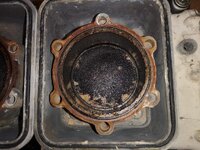
View attachment 69020View attachment 69021View attachment 69022View attachment 69023View attachment 69024
#3.
If applicable...
Your correct on new gaskets/seals.
Use the same pistons with new needle bearings & new rings. With new rings, hone, need that cross hatch.
If I can make chicken salad out of chicken sh**, so can you.
Just don't step over a dollar to get to a dime.
You got this.
ps. Chicken salad does have a short expiration date.
 
I would remove the cylinders and look inside the bottom end, check the crankshaft. The top end is in rough shape so keeping any pieces parts out of the bottom is the goal. If the carb was off the engine, the crank probably looks the same as the top end but good inspection would reveal the condition. I always flush the bottom end really good with diesel, let is sit, rotate the crank many times. Dump it out, blow it out and dry it especially the two little drain holes below the cylinders (I also drip oil into these holes and into the bearing cavity before final assembly) . Before flushing with oil.... I check for bad bearings, especially connecting rod bearings. Then if all is well, I flush with a good amount of two stroke oil and let it sit a few days. I don't replace crank seals unless I see a need to remove the cranks.

If you remove the crank, the process is less time consuming as you can visually inspect all the components and rotate each individual bearing to verify good condition. If you remove the crank, replace the seals. Good Luck !!
 
Oof... definitely check those crank bearings. If the top end is rusted, i bet the bottom is as well. Complete rebuild will be needed if so. The rust on those cylinder walls looks pretty bad, will probably need at least .25 bore to fully remove it.
 
One thing about the crank/lower end - its filled with oil and rotating it the crank looks ok (no rust).
The engine was stored in a garage apparently for 2 years after removal from a seadoo that had a 720 swapped in it.

What kind of hone tool is recommended? Seen a few types that attach to a drill, and heard there's pro's and cons to them.
 
Last edited:
Filled with oil? Hope the crank seals are not bad. As for honing, I doubt you’ll hone out that rust. You need a new top end at the minimum.
 
Inner crank seals are leaking. I wouldn't roll the dice. May as well fix it right and be one. You don't want to go that far and peice meal it. New or rebuilt crank.

Here is a thought, you could ask the previous owner if he poured oil in the bottom end. If not, the inner crank seals are leaking.
 
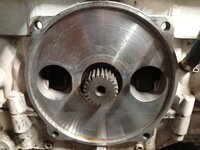
Rotary valve cover has a slight scratch on the engine - how to smooth it out/resurface? Heard of people using 2000 grit sandpaper for light scratches. Pics of the rave valve cover :
rotary valve surface.jpg
 
Last edited:
Scratches are not a problem. Gouges that extend from port to port are a problem. That looks to be in good condition from what I can tell from the picture. You can pressure up the rotary valve cavity pretty easy from that point. Plug the outlet and put an air line on the inlet with a gauge. 5 pounds or so, no more than 8psi. That will let you know if your inner seals are leaking at which point you need to rebuild the crankshaft. Good Luck
 
This engine appears to be a rebuild as the paint is not the cream gloss color like my original blown engine, but instead a non gloss powder white like the SBT rebuilds are. No SBT sticker on it though.
 
Last edited:
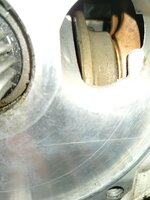
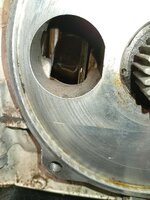
On further inspection, crank on the flywheel side is not full of oil, or have much of any in it at all, and on the PTO side it has some oil in it but not filled up (turning the crank it picks up a coat of oil like shown in the second pic). Not sure how much oil should be in the bottom of the case when sitting, or if there's normally anything more than a coating on the bottom or more. Pics :
crank pic flywheel side.jpgcrank pic pto side.jpg
 
Scratches are not a problem. Gouges that extend from port to port are a problem. That looks to be in good condition from what I can tell from the picture. You can pressure up the rotary valve cavity pretty easy from that point. Plug the outlet and put an air line on the inlet with a gauge. 5 pounds or so, no more than 8psi. That will let you know if your inner seals are leaking at which point you need to rebuild the crankshaft. Good Luck
Just ordered a liquid filled 30psi pressure gauge today to do the test. My diy popoff tester has a 100psi gauge that makes it difficult to accurately get 5psi into the system. The 30psi has 1 increment measurements on it so should be easy. Should get it in a couple of days and then its fingers crossed!
 
Gauge came in and engine lower case holds 5psi for one hour so inner crank seals good, whew!

How to test the outer seals? Full engine pressure test I presume.
 
Last edited:
Will replace that cylinder jug with a good one from the blown engine in the SPI. Luckily the broken off piece would have just traveled and expelled thru the cooling system.
 
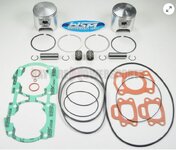
Found a machine shop to bore the cylinders and he recommended to bore out .50 instead of .25 from the stock 76mm size, says for a 2 stroke it will clean them up better. Looking at getting this top end rebuild kit, not sure if it includes the Carb/intake cover gasket and rotary valve cover o-ring or not.
Rebuild kit .50 over Pistons w gaskets.JPG
 
If they haven’t even measured the bores yet and want to go 0.50 over you need to find a different machine shop. You always go the minimum needed to clean them up and never decide or order parts until you measure the bores and check for damage.
 
Anyone use these type of telescopic bore gauges( T gauges) to measure cylinder bore sizes? For $20, looks like something useful for the home garage in conjunction with a good set of calipers.
telescopic bore guage set.JPG
 
PTO is off, pipe wrench and 4foot pipe, came off on 3rd try and didn't need to heat it. Nice silver paint on the PTO scraped up but not too hard at all. Minimal oil on back of PTO and around seal area.
 

Attachments

  • IMG_20260502_122622.jpg
    IMG_20260502_122622.jpg
    620 KB · Views: 5
  • IMG_20260502_122632.jpg
    IMG_20260502_122632.jpg
    536.5 KB · Views: 5
  • IMG_20260502_122705.jpg
    IMG_20260502_122705.jpg
    472 KB · Views: 4
Anyone use these type of telescopic bore gauges( T gauges) to measure cylinder bore sizes? For $20, looks like something useful for the home garage in conjunction with a good set of calipers.
View attachment 69492
Anyone use these type of telescopic bore gauges( T gauges) to measure cylinder bore sizes? For $20, looks like something useful for the home garage in conjunction with a good set of calipers.
View attachment 69492
I’ve never used this type of bore gauge but I’m guessing they are a little harder to be accurate with than a dial bore gauge, I have a Fowler dial bore indicator that covers 2 to 6 inches I believe and some Mitutoyo and Starrett calipers. I figured I could cheap out a bit on the dial bore gauge as long as I had good calipers, although I’m very happy with the Fowler. I’m interested to see what you think after using the ones you posted if you get them
 
Anyone use these type of telescopic bore gauges( T gauges) to measure cylinder bore sizes? For $20, looks like something useful for the home garage in conjunction with a good set of calipers.
View attachment 69492

You measure those with micrometers. A lot of machinists don't believe these are accurate but they are. They have their purpose. You just have to know how to use them. You don't "FEEL" with these. You open them so they are at a shallow angle in the bore so a firm pressure on the handle will push past center... ONE TIME... then you measure with micrometers... gently getting a very light feel and that is your size. Takes some practice. It's all about feel and touch. I bought a set of used inside micrometers for 50 bucks for a guy that didn't want them so I have an extra set. Mics are much more accurate but you still need a set of outside mics to transfer the size. I'd say for this type of engine work, they are useless to most people. Pain in the azz but if that's all you have... they work. LOL

Most cylinder shops use a bore gauge. I've seen them but never used one. The look simple.
 
I’ve never used this type of bore gauge but I’m guessing they are a little harder to be accurate with than a dial bore gauge, I have a Fowler dial bore indicator that covers 2 to 6 inches I believe and some Mitutoyo and Starrett calipers. I figured I could cheap out a bit on the dial bore gauge as long as I had good calipers, although I’m very happy with the Fowler. I’m interested to see what you think after using the ones you posted if you get them

Junk for use on cylinder bores in this day and age.
 
Back
Top