



-
This site contains eBay affiliate links for which Sea-Doo Forum may be compensated.
You are using an out of date browser. It may not display this or other websites correctly.
You should upgrade or use an alternative browser.
You should upgrade or use an alternative browser.
2002 Gtx DI won't run in water but runs on the lift just fine
- Thread starter mtnandy
- Start date
- Status
- Not open for further replies.

Piper Mike
Active Member
Get rid of it. That's just the start of your DI nightmare.


mattydipps
New Member
So I let it run hooked up to the hose and it is missing some but will rev just fine. Put it back in the lake and it will not rev and cuts off as soon as I give it gas. What the heck is wrong with this thing !
welcome to the miserable world of the DI motor.. when they run, theyll run perfect.. but as soon as one thing goes wrong its like a ticking time bomb.
We really need for you to either check the engine compression 130-135psi or you fuel pressure 107psi, to see what direction to proceed.
As far as the Seafoam, I would just dilute it, either top off the tank or drain 5gals. and refill tank. Use the drained gas in your car, lawn mower, etc.
Lou
As far as the Seafoam, I would just dilute it, either top off the tank or drain 5gals. and refill tank. Use the drained gas in your car, lawn mower, etc.
Lou
Last edited by a moderator:

DooWacka
Active Member
If you are mechanically inclined you can do a top end rebuild leaving the majority of the motor and everything else in place.
First you should remove the spark plugs and RAVE valves, then hand rotate the PTO flywheel so you can inspect the sides of each piston. You will probably see mangled rings and melted piston through the ports, since the pistons usually get warmest on the exhaust side. Or if a hole in the piston is on top, you could see it with a borescope.
Remove the head and cylinders, leaving the exhaust manifold in place. Pistons and sleeves (if needed) can be purchased many places online. Since pistons are aluminum and sleeves are steel, the sleeve may only need honing, depending upon the damage. You probably want to get a local machine shop to replace sleeves if needed, or they can be bored slightly and purchase oversize pistons. I have also heard of people replacing the sleeves by just heating the cylinders in the kitchen oven. If you end up going oversize on the pistons, you need to trim the RAVEs a bit to avoid conflict.
The bottom end of the 951 is very sturdy and can handle a top end rebuild fine unless there are a lot of hours on the Doo. Also, make sure you can account for all pieces of the steel piston rings, since falling into the bottom end can cause damage. Usually the rings are just mangled, or melted into the piston.
I have done one top-end rebuild that just needed a new piston and honing in one cylinder. Another rebuild needed a new sleeve.
To avoid this type of overheating and piston melting, I would suggest limiting WOT runs to under a minute or so, then backing off to allow some cooling. That is where I have had problems since ... "there once was a time the lake was so glassy" that LONG periods of WOT were achieved. Since there is no thermostat (like a car), the calibrated water flow orifices are a compromise. You want the motor to get warm enough to operate well, so the water flow is restricted.
The motor could also be running lean to cause overheating. This could be from a fuel pump that is weakening so as not to provide enough flow at WOT. Also, these DI are made to run on 91 octane fuel, so if you run a lower grade, the knock sensor allows the MPEM to adjust timing to accommodate. If the knock sensor is faulty, timing is not adjusted, and the motor will overheat.
First you should remove the spark plugs and RAVE valves, then hand rotate the PTO flywheel so you can inspect the sides of each piston. You will probably see mangled rings and melted piston through the ports, since the pistons usually get warmest on the exhaust side. Or if a hole in the piston is on top, you could see it with a borescope.
Remove the head and cylinders, leaving the exhaust manifold in place. Pistons and sleeves (if needed) can be purchased many places online. Since pistons are aluminum and sleeves are steel, the sleeve may only need honing, depending upon the damage. You probably want to get a local machine shop to replace sleeves if needed, or they can be bored slightly and purchase oversize pistons. I have also heard of people replacing the sleeves by just heating the cylinders in the kitchen oven. If you end up going oversize on the pistons, you need to trim the RAVEs a bit to avoid conflict.
The bottom end of the 951 is very sturdy and can handle a top end rebuild fine unless there are a lot of hours on the Doo. Also, make sure you can account for all pieces of the steel piston rings, since falling into the bottom end can cause damage. Usually the rings are just mangled, or melted into the piston.
I have done one top-end rebuild that just needed a new piston and honing in one cylinder. Another rebuild needed a new sleeve.
To avoid this type of overheating and piston melting, I would suggest limiting WOT runs to under a minute or so, then backing off to allow some cooling. That is where I have had problems since ... "there once was a time the lake was so glassy" that LONG periods of WOT were achieved. Since there is no thermostat (like a car), the calibrated water flow orifices are a compromise. You want the motor to get warm enough to operate well, so the water flow is restricted.
The motor could also be running lean to cause overheating. This could be from a fuel pump that is weakening so as not to provide enough flow at WOT. Also, these DI are made to run on 91 octane fuel, so if you run a lower grade, the knock sensor allows the MPEM to adjust timing to accommodate. If the knock sensor is faulty, timing is not adjusted, and the motor will overheat.

AdamXP800
Well-Known Member
Yes, you could do a top end. But, with an aging crank I think a full rebuild is well worth. If you figure the time and cost of a top end and the possibility of the bottom end going out I think your better off with a rebuild and 2 year warranty. That is if that is what the doo needs.
Thanks for the awesome replies ! The engine has 140 hrs on it . I guess I just need to pull the head and cylinders and see what damage I have. If I just do the top end rebuild there are some kits that include rebuilt heads pistons and all other needed parts - about 300 to 400 dollars. It also sounds like based on the excellent instructions from Doowacka that I should also replace the fuel pump. Anything else you guys can think of ?
DooWacka
Active Member
Just for clarification:
You can see through the RAVE valve ports to inspect the piston damage, WITHOUT removing the head or cylinders.
The fuel pump is only ONE possibility of the localized overheating.
You shouldn't need a "rebuilt head".
If you are planning on doing the top-end rebuild, as a heads-up, guard against dropping anything (needle bearings, piston pin circlips) into the bottom end. Be sure to order the DI pistons, not the Carb pistons. The pistons start at about $80 on eBay, and the sleeves are also about $80.
You can see through the RAVE valve ports to inspect the piston damage, WITHOUT removing the head or cylinders.
The fuel pump is only ONE possibility of the localized overheating.
You shouldn't need a "rebuilt head".
If you are planning on doing the top-end rebuild, as a heads-up, guard against dropping anything (needle bearings, piston pin circlips) into the bottom end. Be sure to order the DI pistons, not the Carb pistons. The pistons start at about $80 on eBay, and the sleeves are also about $80.
Last edited by a moderator:
Just for clarification:
You can see through the RAVE valve ports to inspect the piston damage, WITHOUT removing the head or cylinders.
The fuel pump is only ONE possibility of the localized overheating.
You shouldn't need a "rebuilt head".
If you are planning on doing the top-end rebuild, as a heads-up, guard against dropping anything (needle bearings, piston pin circlips) into the bottom end. Be sure to order the DI pistons, not the Carb pistons. The pistons start at about $80 on eBay, and the sleeves are also about $80.
Ok will check it out . Thanks so much for the great advice. What do you think about the top end kits that come complete with everything you need including rebuilt cylinder head
DooWacka
Active Member
I assume you mean rebuilt cylinders, and not "head".
I have never seen a kit that has a head, so show a link if you are looking at one.
Someone may have a kit with a milled head to increase the compression.
If you are talking about the kits that have cylinders and pistons already matched up, and ready to install, with gaskets, then that is an option for you. These usually require you to send in your cylinders, or at least send them in as a core. They just bore out the cylinders and match up with oversize pistons. If you find a reputable shop or exchange service, then they save you the thinking and possibility of doing something wrong. This would be beneficial especially if you find significant damage in both jugs. If you just need one new STD size piston then it wouldn't be economical to buy the whole kit. As far as gaskets, you will need a new head gasket, but unless you damage the others, they should be fine.
I have never seen a kit that has a head, so show a link if you are looking at one.
Someone may have a kit with a milled head to increase the compression.
If you are talking about the kits that have cylinders and pistons already matched up, and ready to install, with gaskets, then that is an option for you. These usually require you to send in your cylinders, or at least send them in as a core. They just bore out the cylinders and match up with oversize pistons. If you find a reputable shop or exchange service, then they save you the thinking and possibility of doing something wrong. This would be beneficial especially if you find significant damage in both jugs. If you just need one new STD size piston then it wouldn't be economical to buy the whole kit. As far as gaskets, you will need a new head gasket, but unless you damage the others, they should be fine.
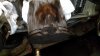
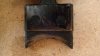
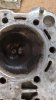
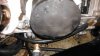
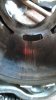 [ATTACH= I have now taken the head and cylinders off and I found a damaged piston, damaged cylinder sleeve, and damaged head. My thoughts are too replace the cylinder and pistons, rings and reinstall with the same head . I will clean up the head and file down any high spots where it was dented. What do you guys think ? Also should I suck out the oil in the crankcase and if so what type should go back in and how much ?
Attachments
Last edited by a moderator:
DooWacka
Active Member
The pic of the piston looks like a piece of ring is missing. If so, that may be what was "banging" around against the head before it went out the exhaust. If you are not missing a ring piece, then the pocking or pits could be from detonation, which would also explain the overheating. You can read up on "detonation" on this forum and elsewhere.
Yes, you can probably smooth out the combustion dome of the head and re-use it, with only negligible loss of performance
Remember this is a 2-stroke so their is no "crankcase oil" to suck out. The small amount of oil used is injected into the case to lube everything. Just don't drop anything in the case while working. It looks like you may have some white rags stuck in there just for that purpose.
Also, don't let the rods bang against the case edge to make a "burr", to interfere with the cylinder to case seal.
Yes, you can probably smooth out the combustion dome of the head and re-use it, with only negligible loss of performance
Remember this is a 2-stroke so their is no "crankcase oil" to suck out. The small amount of oil used is injected into the case to lube everything. Just don't drop anything in the case while working. It looks like you may have some white rags stuck in there just for that purpose.
Also, don't let the rods bang against the case edge to make a "burr", to interfere with the cylinder to case seal.
Last edited by a moderator:
The pic of the piston looks like a piece of ring is missing. If so, that may be what was "banging" around against the head before it went out the exhaust. If you are not missing a ring piece, then the pocking or pits could be from detonation, which would also explain the overheating. You can read up on "detonation" on this forum and elsewhere.
Yes, you can probably smooth out the combustion dome of the head and re-use it, with only negligible loss of performance
Remember this is a 2-stroke so their is no "crankcase oil" so suck out. The small amount of oil used is injected into the case to lube everything. Just don't drop anything in the case while working. It looks like you may have some white rags stuck in just for that purpose.
Also, don't let the rods bang against the case edge to make a "burr", to interfere with the cylinder to case seal.
Thanks for the awesome review and info. I plan on getting the top end kit with cylinders from Full Bore. Do you think they are a good source ?
- Status
- Not open for further replies.
Similar threads


- Replies
- 9
- Views
- 745


- Replies
- 19
- Views
- 1,894