


• This site contains eBay affiliate links for which Sea-Doo Forum may be compensated.

Rotary valve gear lubrication question...

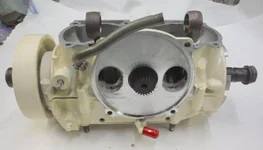
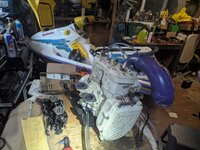
Hi guys, me again..so a bit has transpired with the "new to me" 95 Seadoo XP I bought.

The 657x under the hood turned out to be trashed, water in the lower part of the motor washed the bearings and it's junk..I found a good, clean, low hour 657 bottom end complete on Ebay.

Now, I've been thinking about this oil delete the previous owner did also.

The guys did a piss poor job of looping the oil line to keep the sump filled and it pissed all the fluid out into the hull and destroyed the gear...a real cock up for sure!!

Anyway, it's all in the wash anyway with the new bottom end coming!

So my plan and my question:

1st the oil tank is removed and I want something better than just a hose loop filled with lube in the bottom of the hull. LAME!

I've ordered a new 250ml oil reservoir tank and will be fixing it inside the hull someplace..then running new hoses to either side of the motor to keep the sump on my new lower WET!! A newly designed loop system I can check and monitor regularly..clever right?? ;)

Now the question..what oil to put in the sump?

I question if 2stroke oil is optimal lube for a brass helical gear or is it just adequate and a matter of convenience since there is a tank full of the stuff onboard that can be tapped into? Like Seadoo has done all these years?

Maybe the reason many of these old machine burn out their seals and start dumping into the crankcase is because of the fact it's not the best oil for this task....?? And there is a hundred threads about stripped rotary gears>?

I'm thinking more in line with some API GL-4 gear lube and in fact the interweb suggest if might be a better choice for a helical gear drive for various reasons. A half billion outboard lower units couldn't be wrong!

Surely someone else has thought this same thing..?? Thoughts...??
 

Attachments
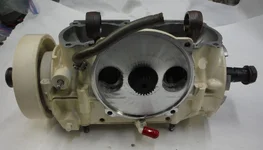
  • s-l1600.webp
    s-l1600.webp
    128 KB · Views: 13
Last edited:
Easy answer to your questions. The gear and seals were designed to use API-TC oil so just use API-TC oil. I have never seen one fail in 35 years of working on these that didn't have mechanical damage cause it, like a bolt down the intake.

Also make sure you pressure test your new used engine to 8 psi to be sure those used crank seals are good and the engine is air tight.
 
Be sure to vent this new oil tank, the fitting beneath the exhaust is just a vent hose that should go to the top of the oil tank.
I’m going to make a guess and say that a lot of the damaged brass gears are from people changing the rotary valve gear without splitting the cases
 
Be sure to vent this new oil tank, the fitting beneath the exhaust is just a vent hose that should go to the top of the oil tank.
I’m going to make a guess and say that a lot of the damaged brass gears are from people changing the rotary valve gear without splitting the cases
No in this specific case I'll say the damage was lack of oil..as I mentioned, the PO created a sketchy hose loop during his pump delete. Then didn't properly secure it with clamps..

The oil pissed out while the engine was running and was sitting in the hull..

When I split the case to investigate the obvious bearing noise I was hearing, I found the sump area full of gold sprinkles.
 
No in this specific case I'll say the damage was lack of oil..as I mentioned, the PO created a sketchy hose loop during his pump delete. Then didn't properly secure it with clamps..

The oil pissed out while the engine was running and was sitting in the hull..

When I split the case to investigate the obvious bearing noise I was hearing, I found the sump area full of gold sprinkles.
That will do it, I guess that’s one of the few benefits to pre mixing. The gold sparkles won’t be spread through the oil injection system as well
 
Easy answer to your questions. The gear and seals were designed to use API-TC oil so just use API-TC oil. I have never seen one fail in 35 years of working on these that didn't have mechanical damage cause it, like a bolt down the intake.

Also make sure you pressure test your new used engine to 8 psi to be sure those used crank seals are good and the engine is air tight.
Sure will test everything before reassembly..

I understand what you're saying about the API-TC. But at the same time, it's really just a 2stroke oil with good burn characteristics..not so much designed for as a gear lubricant. It's like an after-thought of it's formulation.

I'm looking for something with similar viscosity and API qualities to allow flow and to lubricate the gearing while protecting the seals..something that is specialized for that task.

Realizing API GL-4 is a heavy gear lube, I can't say I was entirely serious about that..

But perhaps something along the line of Ford Mercon V ATF as it's viscosity if nearly identical, it's seal protection additives are exceptional and it's specifically designed for gear lubrication!

I realized I'm asking a long term Seadoo to think outside the box..but does it not seem that this might be a good alternate?
 
Be sure to vent this new oil tank, the fitting beneath the exhaust is just a vent hose that should go to the top of the oil tank.
I’m going to make a guess and say that a lot of the damaged brass gears are from people changing the rotary valve gear without splitting the cases
Yeah, the tank I chose has a supply and return..just to ensure that any air in the sump can get back to the tank and ensure the gear is fully bathed at all times.
 
That will do it, I guess that’s one of the few benefits to pre mixing. The gold sparkles won’t be spread through the oil injection system as well
The oil doesn't circulate so the debris for the rotary gear can't get to the oil injection part. Also there is and inline oil filter for the injection pump.
 
Sure will test everything before reassembly..

I understand what you're saying about the API-TC. But at the same time, it's really just a 2stroke oil with good burn characteristics..not so much designed for as a gear lubricant. It's like an after-thought of it's formulation.

I'm looking for something with similar viscosity and API qualities to allow flow and to lubricate the gearing while protecting the seals..something that is specialized for that task.

Realizing API GL-4 is a heavy gear lube, I can't say I was entirely serious about that..

But perhaps something along the line of Ford Mercon V ATF as it's viscosity if nearly identical, it's seal protection additives are exceptional and it's specifically designed for gear lubrication!

I realized I'm asking a long term Seadoo to think outside the box..but does it not seem that this might be a good alternate?
Well the injection oil lubricates the crank bearings, rod bearings and pistons even diluted with gasoline so it should be perfectly fine for the brass gear and shaft bearings and full strength. Seriously, you are overthinking this. Think of the thousands that are still running with this oil and no wear even 30 years later.

There is no proof that gear oil is good or bad, ATF is really not the best for this applicationa nd could have seal issues. API-TC is proven to work 100% so why reinvent the wheel? Do you really think the people that designed the engine were just using theis spec oil for the fun of it? No, they knew it would work and didn't want any warranty claims.
 
I hear you..just drawing on 25 years in the automotive industry for example.

We all know there are aftermarket creative design ideas out there that are better than OEM in any industry.

As this machine already has a pump delete I figured I'd explore other ideas while I'm in the process of rebuilding it..maybe make a good system a bit better.
 
The oil doesn't circulate so the debris for the rotary gear can't get to the oil injection part. Also there is and inline oil filter for the injection pump.
I knew that the oil doesn’t circulate but I was sure I had seen people post in the past that the fine brass shavings had made it into the oil tank? Maybe I’m mistaken
 
Being a retired engineer who designed parts for a living, it gives me chills when I listen to anyone assuming the folks who make OEM stuff are in the dark about their product and only spend their time going to meetings to figure out how to save a few pennies. Sure there are the meetings where minutes are kept and hours are lost. But the guys spending 40 hours plus a week with decades of experience have thought about these issues. And yes I was one of those guys and yes I did make a few mistakes. I take responsibility for those even though parts were reviewed by multiple other engineers who had their own specialties and they missed something too.

Brass is decorative and cheese is stronger. Bronze makes a good gear since it is strong and slippery. AL-Ni-Br is much better. Cu-Be is the last step up the ladder. It has machining issues being carcinogenic and the surface hardness is close to hard steel. If you pick the wrong materials, no sort of different lube will save the design. And does the design really need fixing?
 
Starting to come up to the surface on the oil pump deep dive & this rotary gear lubrication/sealing is the next bridge I'm going to cross.
Done a lot homework on this particular aspect going as far as consulting with ultralight/Rotax enthusiast forums along with a few phone calls. 2,000 feet in the air compels one to stick to the smallest details in engine reliability/performance.
In their words, religious preventive maintenance & the proper lubrication regiment, no half measure. No one & done. Stay on top of it & land by your command, not gravity's.
That word regiment.
A plurality
of "enthusiast" go closed loop with proper two stroke oil with proper venting. Since there is no circulation, a gentile forced purge of the cavity then replaced with fresh. The used oil is analyzed for particulate's/metals.
All synthetic oils looses its lubricity over time. The rotary gear oil flush is a very pragmatic approach to ensure longevity.
Their words, not mine.
So it boils down to whose word your going to take, the Red Barron 2,000 feet in the air or Jimmy Buffet @ lake level?
I'll cross this bridge when the time comes...
 
Last edited:
Being a retired engineer who designed parts for a living, it gives me chills when I listen to anyone assuming the folks who make OEM stuff are in the dark about their product and only spend their time going to meetings to figure out how to save a few pennies. Sure there are the meetings where minutes are kept and hours are lost. But the guys spending 40 hours plus a week with decades of experience have thought about these issues. And yes I was one of those guys and yes I did make a few mistakes. I take responsibility for those even though parts were reviewed by multiple other engineers who had their own specialties and they missed something too.

Brass is decorative and cheese is stronger. Bronze makes a good gear since it is strong and slippery. AL-Ni-Br is much better. Cu-Be is the last step up the ladder. It has machining issues being carcinogenic and the surface hardness is close to hard steel. If you pick the wrong materials, no sort of different lube will save the design. And does the design really need fixing?
No disrespect to engineers intended..without them great design strides wouldn't happen in any field.

But with 40 years of mechanical knowledge I've seen many examples of engineering to practical application disconnect...

From VW's design on an automobile that means a subframe and steering rack needs to be removed to access a rusted turbo coolant tube for replacement. A $15 part...7 hours of work.

Kawasaki motorcycles that have a wild temperature swing during operation only to have a non-engineer type create a coolant line bypass to stop the flow block at the thermostat housing an engineer blueprinted there and didn't change for 20 years of production. A kit now called a 'Thermo-Bob' to solve is $40 on Amazon..named for it's inventor. I used it..worked perfectly on my KLR650!

And don't get me started why an engineer needs a meeting to discuss how to save a penny on a bolt or fastener by using a material that will last til warranty periods have ended, then cost the owner hundreds further down the road because it wasn't made of something better...

Ford MoCo used a head gasket in their 3.8l V6 from 1978 to 1995 in 10s of thousands of vehicles that failed like clockwork 10-20k after warranty period...an engineer decided it's design was FINE and kept making the same way for 17 years before the internet blew into the scene and exposed it. Forcing FoMoCo to redesign..

I could keep going.....there are hundreds of examples and like this!

So before you get butthurt because someone is questioning your brethren and considers thinking outside the OEM box on simple lubrication types, maybe realize....it's pretty big can of worms you'll open to shame them for overthinking an engineer!

Even with their engineering degrees, engineers don't have the market cornered on brains and certainly not good ideas!!

I've seen some of the brightest design 'bush-fixes' come from guys with missing teeth and greasy hands...

The reason I came to the 'dirty hands club' to ask these questions.

If the mere discussion of this so offends the engineer in you and gives you "chills"..relax a bit would you!!

I didn't some here to stir up crap or troll, I just asked a bloody question!! You took it down this path...
 
Last edited:
Yeah, the tank I chose has a supply and return..just to ensure that any air in the sump can get back to the tank and ensure the gear is fully bathed at all times.
Very interested in that tank you got with return/supply. The only small tank I could get had one nozzle & it was @ the bottom which is a good thang but does not have a second nozzle. I will probably have to put some chicken sh engineering on it & put that 2nd nozzle just in the right area to facilitate accurate level readings. I'll either make chicken salad, or not.
Anyway, we seem to share the same concerns regarding the RV gear cavity.
My focus & perhaps yours also are the two inner seals & their health.
Seen these seals on numerous screw compressors, they work & work well & when they fail, it's just because their old, tired & not that hard to replace. (Kinda mirrors my life @ this juncture) Most compressor companies have them scheduled for "preventive" replacement every 5 years or hour threshold.
These two seals stuck to a crank shaft in what could be considered a violent environment? Umm, ok.
So, that being said. No mystery here, room for improvement with dedicated install & thoughtful, applicable & minor "re-engineering" to improve the odds.
By the way, I've been in the middle of the theory-vs- application kerfuffle with the suit & ties. Most engineers welcome the feedback & act upon the field results. Some do not. They were shown the door in short order.
OIP.jpg
 
Very interested in that tank you got with return/supply. The only small tank I could get had one nozzle & it was @ the bottom which is a good thang but does not have a second nozzle. I will probably have to put some chicken sh engineering on it & put that 2nd nozzle just in the right area to facilitate accurate level readings. I'll either make chicken salad, or not.
Anyway, we seem to share the same concerns regarding the RV gear cavity.
My focus & perhaps yours also are the two inner seals & their health.
Seen these seals on numerous screw compressors, they work & work well & when they fail, it's just because their old, tired & not that hard to replace. (Kinda mirrors my life @ this juncture) Most compressor companies have them scheduled for "preventive" replacement every 5 years or hour threshold.
These two seals stuck to a crank shaft in what could be considered a violent environment? Umm, ok.
So, that being said. No mystery here, room for improvement with dedicated install & thoughtful, applicable & minor "re-engineering" to improve the odds.
By the way, I've been in the middle of the theory-vs- application kerfuffle with the suit & ties. Most engineers welcome the feedback & act upon the field results. Some do not. They were shown the door in short order.
View attachment 68965
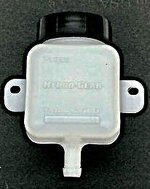
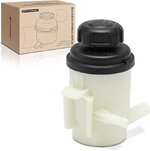
I actually found a tank that will work well for $9 on Amazon..power steering pump reservoir for a 2006-2010 Sonata. It's perfect..lower hose is correct size, the top is smaller and I'll have to adapt to fit. But a great start I think..I'll get it mounted and plumbed soon.

I still haven't decided fully on what lube to fill it with..my thoughts are on ATF? It's viscosity is the same as 2stroke and it's designed for high temperature, heavy gear load applications and is seal friendly..but as I won't be running it til the weather changes up here in the great white north, so it's not important at the moment.

I hear you about the crank seals..I'm gonna have to chance that the clean lower unit I bought is as good on the inside as it was on the outside!! It's back together now and waiting for 1st run..fingers crossed!

It was super clean and from a low hour motor..so confidence it high!

Not too worried about the resistance from members of the engineering community..I've known a few and they can be a bit tightly wound at times. Doesn't concern me..

I've always found the best answers come from the guys with the dirtiest hand anyway! That's why I came here with questions..
 

Attachments

  • 61lDtaf74ZL._AC_SX679_.jpg
    61lDtaf74ZL._AC_SX679_.jpg
    32.6 KB · Views: 5
  • s-l1600.webp
    s-l1600.webp
    48.7 KB · Views: 6
  • PXL_20251227_203546759.jpg
    PXL_20251227_203546759.jpg
    738.5 KB · Views: 5
I actually found a tank that will work well for $9 on Amazon..power steering pump reservoir for a 2006-2010 Sonata. It's perfect..lower hose is correct size, the top is smaller and I'll have to adapt to fit. But a great start I think..I'll get it mounted and plumbed soon.

I still haven't decided fully on what lube to fill it with..my thoughts are on ATF? It's viscosity is the same as 2stroke and it's designed for high temperature, heavy gear load applications and is seal friendly..but as I won't be running it til the weather changes up here in the great white north, so it's not important at the moment.

I hear you about the crank seals..I'm gonna have to chance that the clean lower unit I bought is as good on the inside as it was on the outside!! It's back together now and waiting for 1st run..fingers crossed!

It was super clean and from a low hour motor..so confidence it high!

Not too worried about the resistance from members of the engineering community..I've known a few and they can be a bit tightly wound at times. Doesn't concern me..

I've always found the best answers come from the guys with the dirtiest hand anyway! That's why I came here with questions..
I search high & low for the right tank & came up with something less.
That tank of yours fits the the bill perfectly.
Thanks for sharing that find!👍
 
I actually found a tank that will work well for $9 on Amazon..power steering pump reservoir for a 2006-2010 Sonata. It's perfect..lower hose is correct size, the top is smaller and I'll have to adapt to fit. But a great start I think..I'll get it mounted and plumbed soon.

I still haven't decided fully on what lube to fill it with..my thoughts are on ATF? It's viscosity is the same as 2stroke and it's designed for high temperature, heavy gear load applications and is seal friendly..but as I won't be running it til the weather changes up here in the great white north, so it's not important at the moment.

I hear you about the crank seals..I'm gonna have to chance that the clean lower unit I bought is as good on the inside as it was on the outside!! It's back together now and waiting for 1st run..fingers crossed!

It was super clean and from a low hour motor..so confidence it high!

Not too worried about the resistance from members of the engineering community..I've known a few and they can be a bit tightly wound at times. Doesn't concern me..

I've always found the best answers come from the guys with the dirtiest hand anyway! That's why I came here with questions..
The power steering tank is on it's way.
Hitting a brick wall though on a 3-way fuel valve with 12mm-1/2" ports. The ones offered are rather bulky taking up too much "prime real-estate".
The 3 way would serve as shut-off, main supply then divert so as to purge. Tall order in a small 12mm 3-way.
If by chance you run across one in your travels, drop a line. I'll buy you a burger.
Me? I'll be scouring the market also for one.
 
The power steering tank is on it's way.
Hitting a brick wall though on a 3-way fuel valve with 12mm-1/2" ports. The ones offered are rather bulky taking up too much "prime real-estate".
The 3 way would serve as shut-off, main supply then divert so as to purge. Tall order in a small 12mm 3-way.
If by chance you run across one in your travels, drop a line. I'll buy you a burger.
Me? I'll be scouring the market also for one.
That does sound a challenging find...I'll keep my eyes open for you.
 
You are going to chance getting ATF fluid or any other non 2 stroke oil into the crankcase and destroying the engine? Why?
 
You are going to chance getting ATF fluid or any other non 2 stroke oil into the crankcase and destroying the engine? Why?
I'm open to any discussion or input..the reason I started the discussion.

As the oil injection system is now deleted and the tank is removed by previous owner, I'm creating a sealed system with a reserve tank strictly for the task of rotary gear lubrication.

Seadoo uses 2stroke oil simply because they can tap into the tank, that is no longer there, and avoid the need for a second lubrication source for the gear. Adequate, but perhaps there is something better?

Maybe it contributes to crank seals fail long term..god knows there is enough discussions here about this failure!!

2stroke oil formulations are designed to protect hard engine parts while being combustible and non-accumulating in the engine.

Maybe in the long term, this formulation degrades or hardens the seals where ATF doesn't??

A billion working gearboxes, transmissions and final drive systems use ATF as it's properties are designed specifically for gears, seals and high temperature operation can't be wrong!

..perhaps it's a better option!

Your opinion is welcome..but do you have have anything to offer to suggest why it will destroy the engine to substitute?
 
From what I understand, the seals do not fail, they start to spin in the case grooves causing the leaks. That is why they say to put
sealant in the case grooves when you rebuild one to keep the seals from spinning.

All am saying is, if for some reason the AFT does leak into the crankcase and contaminates the 2 stoke oil, you could do some damage.
Why chance it when the 2 stroke oil setup has worked for 30+ years.

I see what you are trying to do since the oil tank is gone, but I would not run anything but full synthetic 2 stroke oil in the RV cavity. That
way if any does leak past the seals , it is just 2 stroke oil going into the crankcase. Just my 2 cents.
 
Last edited:
From what I understand, the seals do not fail, they start to spin in the case grooves causing the leaks. That is why they say to put
sealant in the case grooves when you rebuild one to keep the seals from spinning.

All am saying is, if for some reason the AFT does leak into the crankcase and contaminates the 2 stoke oil, you could do some damage.
Why chance it when the 2 stroke oil setup has worked for 30+ years.

I see what you are trying to do since the oil tank is gone, but I would not run anything but full synthetic 2 stroke oil in the RV cavity. That
way if any does leak past the seals , it is just 2 stroke oil going into the crankcase. Just my 2 cents.
If the crank seals fails the engine is doomed anyway and hitting the bench for a full rebuild...

I can't see how the type of oil in the gear sump will make any difference or do more damage!
 
A little 2 stroke oil could migrate from the CR cavity into the crankcases during normal operation. I do not know if it does or not. But if
it does and you have ATF fluid in there instead and it creeps into the crankcases and contaminates the 2 stroke oil, I feel it could cause a lubrication
problem and fry the motor. I would never take that chance or want to worry about if it would.
 
I am not butt hurt at all.

I too come here for the real world knowledge and experience. "I have never seen one fail in 35 years of working on these that didn't have mechanical damage cause it, like a bolt down the intake." That statement makes perfect sense to me. The rotary valve shaft is driving a spinning plate and an oil pump so very little load. It is way different than a car transmission or differential reacting the weight of a vehicle.

I come from the commercial aircraft business and have worked trough years of problems caused by fluid and seal material tewaks that went terribly wrong. Seals swelling or shrinking are a bad thing. Seals are a black art.
 
Back
Top